Nichols, Megan Ray, Seth Leonard, Chris, Clayton Hooper, Kathrin Diaz, Lund, Lorene, and Belle. “The Top 10 Environmental Issues Should Make You Worry.” Schooled By Science. 27 June 2018. Schooled By Science. 06 Mar. 2019 <https://schooledbyscience.com/environmental-issues/>.
The food chain becomes very relevant in the ocean especially with certain predators whom may be larger than most. However, now a days one of the oceans most important predator, and role in the food chain, has become threaten. This species is the shark. As we know sharks are perceived as dangerous and violent but that doesn’t stop some individuals from cutting off their precious fins.
It has been a tradition or practice to some to cut off hark’s fins and throw them back into the ocean where their left to helplessly die. The processes of shark fining start with fishermen arriving at location they know most sharks travel. Then they’ll use some sort of bait to lure them in towards the boat and the fishermen’s desire. Once the shark is caught it is immediately de-finned and tossed back into the water. Then due to large amounts of blood loss and inability to swim, the sharks lay on the sea floor suffocated to death.
In addition the shark ins are used as an ingredient to make shark fin soup. Shark fin soup is a Chinese cuisine that is viewed as very luxurious. Thus, it is only served on special occasions such as wedding or banquets yet, this dish is not healthy for the human body.
Since Sharks are on the top of the food chain in the oceans ecosystem, their disappearance does no good to the rest of the animals below them in the food web. If sharks become threatened or even endanger, then the other species the sharks consume would duplicate in number. For that reason, sharks play an important role in the oceans ecosystem.
The exact definition of over fishing , according to the WWF website, is when more fish are caught than the population can replace through natural reproduction. The ocean s an environment that we only know 5% of therefore the remaining 95% is filled with marine life varying from the largest fish to the smallest. The ocean is a beautiful place to most and all marine life can agree. However once the beautiful view is destroyed ,from pollution, climate change, over fishing etc., many would say otherwise.
Overfising is one of the many reasons why marine life continues to be at risk. As stated by The Census of Marine life, a 2010 article, an estimation of 80% of big fishes have disappeared from the ocean. An example of this is the Bluefish Tuna who were once located in the North Sea. The story goes that for thousands of years in early 1700s these fishes would be caught in bulks by many fishers in Europe. Due to the fishes location it served as efficient to the people of Northern Europe therefore many would catch as many as they could. However, as this trend continued it back lashed on the people in the beginning of the 19th century. It began when no Bluefish Tuna was to be seen ever again in the ocean.
The dangers of overfishing have been underestimated by many and is because, since fish serves as a delicacy in most countries people see no harm being done. But, fishing is not bad it is the fact that people can not be satisfied with their finding and crave more. Therefore they began to catch rare fish which later become threaten to be endangered. Overall, overfishig has changed the way some scientist view their discoveries. On a lighter note, some scientists are putting together marine protected areas to help save the fish.
Biodiversity loss is the extinction of species worldwide or reduction or loss of species in certain habitats. The loss of Biodiversity doesn’t just focus on the ocean but all species from land to water. Some believe that the loss of biodiversity began when individuals started to interrupt the earth’s ecosystem by, building, tearing down, and polluting its environment.
The reasons for the loss of biodiversity range from human impact and natural phenomenons. The first reason states habitat loss which is when people use deforestation to expand and modernize certain areas, and this is the most commonly known reason. Secondly is Over-exploitation for Commercialization, some began to over exploit common needs or wants for money purposes. However, in some countries, they’ve begun overexploiting certain species for profit matters. For Instance, shrimp farming in India, Thailand, Ecuador, and Indonesia, resulted in wetland destruction.
Invasive Species are known as the second most harmful to the loss of biodiversity. The explanation behind this observation is because these unknown or “rare” species are seen as harmful to biodiversity. These species come into the environment without permission or pre-examined and began to terminate fellow diversity causing drastic losses in commonly known species.
Global or Climate change has also been heavenly brought to awareness by individuals around the world, however, opinion varies whether this observation is proven to be true or not. According to an article, the greenhouse effect is believed to take place soon and raise word temperature about 2 degrees. This implies that sea levels would rise 30-50 cm, meaning most sea life would be at risk of dying out, and only a few species who can obtain the temperatures will live. Furthermore, without biodiversity not only is the earth ecosystem at risk but human lives as well.
Polluted waters are bodies of waters such as lakes, rivers, oceans, and groundwater that are contaminated merely due to human activities. Once contaminants are introduced to the natural environment this is known as the pollution of water. In addition, according to statistics due to unhealthy living environments, one out of every four is killed.
There are various causes of Polluted water however the most common are some that pass by our mind. For Instance, Sewage and Waste Water is one major cause all over the world, mostly in Low Developed Countries but as well can occur in Mostly Developed Countries for the reason of litter. All sewage, garbage, and liquid waste from households are dumped into rivers and lakes. Once the rivers and lakes are contaminated they eventually reach their way to the ocean and sadly that’s when some began to notice the issue. Furthermore, these wastes contain poisonous and toxic chemicals that are harmful to both marine life and humans.
Another cause of water pollution is Dumping which consists of throwing away solid waste and litter into any body of water. Since solid waste, such as glass, plastic, Styrofoam, aluminum, and metals, are thrown away carelessly into the ocean it becomes harmful to marine life. However, Dumping can include Industrial waste as well. Industrial waste usually consists of lead, mercury, asbestos (pollutant), and petrochemicals which are hazardous to all marine life and humans. Most times Industrial Waste is thrown away into rivers and lakes.
Spotted Oceanic Triggerfish, Canthidermis maculata, hiding in the middle of plastic garbage.
Lastly, the most well-known cause is Oil Pollution. Oil Pollution is created by boats, submarines, and any other form of tanks while traveling along the ocean. Since oil does not dissolve into water t instead forms into a thick consistency harming ocean life. In addition, there have been various incidents that involve Oil Spill yet, nothing has changed the way people dispose of all types of waste.
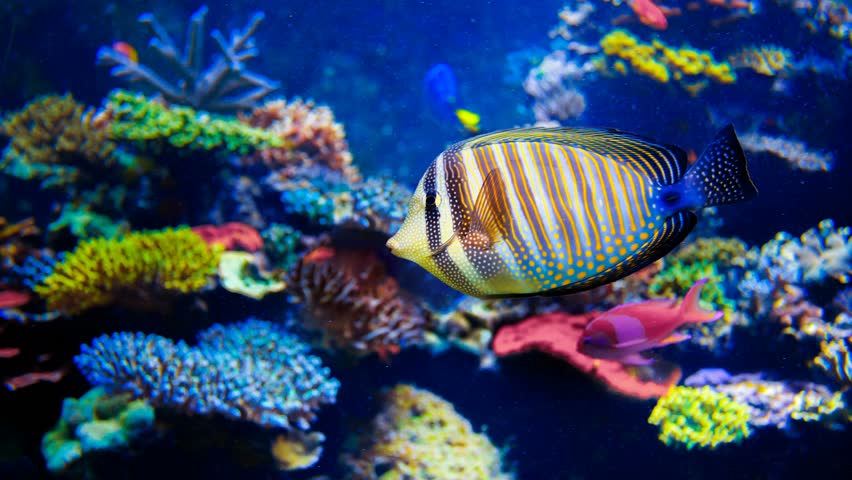
Coral Reefs provide homes to more than a quarter of most marine animals such as fish, reptiles, seaweeds, crabs, and thousands of more. According to statistics Coral Reefs only occupy one percent of the ocean floor yet, is endangered of slowly decreasing as years go by. In addition, provide food and natural resources for over 500 million people in various countries.
Coral reefs are essentially animals, grouped together for protection, called polyps who are related to sea anemones. The corals contain tentacles which allow them to feed on plankton at night, and interact with algae that live between their tissues and give the corals their bright colors. Coral provides Carbon Dioxide and wastes that the algae need for photosynthesis which in return benefits the coral with oxygen and the organic products of photosynthesis. In addition, corals live in specific environmental conditions such as tropical and subtropical and, must be near the surface of the water so that the corals can grow.
There are various reasons to the coral reefs decreasing however the most common are overfishing, damaging fishing techniques, pollution in waters, and sewerage effluent. One very damaging fishing technique is the use of a chemical named cyanide. Cyanide is a deadly substance that kills anything that consumes it within minutes or hours. When certain fish who consume seaweed is being overfished, large amounts of seaweed will overgrow corals and slowly kill them.
Development near the shoreline leads the erosion and unnecessary sediments that can fall into the water and block the light and nutrition which is necessary for the corals to grow. Moreover, coral reefs all around the world remain in great danger to decrease in size if people continue to neglect the issue.




 Mysteries from the Depths of the Ocean